
Pipe
Cleaner Penguin
Today's Snack: These cute penguin treats are from Taste
of Home Magazine. You may want to make these the day before, since it takes
time to get these done:

1/2
C. milk chocolate chips
1-1/2
tsp. shortening
12
large marshmallows
2
pkgs. (2-1/4 ounces each)
Tootsie Rolls
12
miniature chocolate chips
18
pieces candy corn
6
cream-filled chocolate sandwich cookies
In a microwave-safe bowl, combine the
milk chocolate chips and shortening. Microwave, uncovered, at 50% power for 1
to 1-1/2 minutes or until chips are melted, stirring every 30 seconds. Cool
slightly.
Place a small amount of chocolate
mixture on top of six marshmallows. Let stand for 1 hour or until set.
Warm the chocolate mixture. For the
penguin bodies, carefully dip sides of the marshmallows in chocolate mixture so
three-fourths of the marshmallows are covered, leaving about 3/4-in. vertical
strip of white. Let stand on waxed paper until set, about 1 hour.
For penguin heads, cut Tootsie Rolls
into two-piece sections. Place on a microwave-safe plate; microwave at 10%
power for 10-15 seconds or until slightly warmed. Carefully roll each into a ball.
With a toothpick, position chocolate
chips for eyes.
For beaks, cut off yellow end of six
candy corn pieces; flatten remaining candy slightly. Press gently into
chocolate balls. Reheat chocolate mixture. Dab a small amount onto bottom of
each ball; position on penguin bodies. Let stand until set, about 45 minutes.
Separate cream-filled cookies; remove
and discard cream filling. For wings, cut six cookies in half. Rewarm the
chocolate mixture. Spread a small amount on each cookie half; attach to penguins
with cut edge facing forward.
For bases, attach penguins to
remaining cookies using melted chocolate. For feet, remove white ends of
remaining candy corn pieces and discard; flatten candy. Attach two candies to
each cookie base. Let stand for 45 minutes or until set.
--------------------
Supplies:
Scissors
Regular-weight pipe cleaners, one for each penguin:
One black
One white
One orange
Optional: two tiny googly eyes
Dots of glue
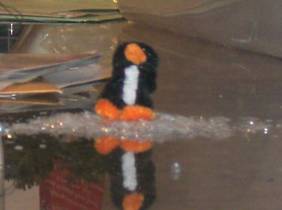
Make this
sweet and silly penguin, and lots of friends and relatives for it if you have
enough pipe cleaners. You can sprinkle some white glitter on the table to
display them and stage a "penguin pageant."
To make a
penguin, take an orange pipe cleaner and bend it in half. Curl the two bottom
tips into tight spirals for "feet." Bend them flat, so that your penguin will
stand upright.
Next, take
the black pipe cleaner, and wrap it around so that enough of the orange is
showing at the top to bend forward into a beak. Wrap and coil the black pipe
cleaner around to the feet, tucking in the end. Arrange the beak and make sure the
penguin still stands steadily on its feet.
Last, but
not least, cut a snip of a white pipe cleaner, bend both tips at the very ends
so that it forms a "C" shape, and then push the two curved ends of the white
section into the black "chest area." The wire on the end of the white section
should nestle inside the black coiled pipe cleaner, and stay put.
If you have
tiny googly eyes, you can glue them on for added fun.
You hardly
ever see penguins by themselves. So make lots of penguins - to make a "colony."
That's the proper word for a bunch of penguins!
 Creative Enrichment and Snack Ideas