
Handwriting Help
Parents,
grandparents, babysitters, mentors, after-school program leaders, and everyone
who cares about children: see the handwriting on the wall, and help the young
person in your life gain better handwriting.
Handwriting?
Didn't they go out of style with the dinosaurs? Don't computer keyboards make
penmanship irrelevant?
No
way. Handwriting is much more brain-building than keyboarding. Think of it this
way:
●
A child who is taught to take care to form the letters correctly will take care
to form words correctly (spelling), and sentences correctly (grammar and
punctuation).
●
A child who forms good penmanship habits will like getting things right, and
that foretells good results in thinking, studying, listening and reflection.
●
Teachers and others think you are more intelligent and organized if your
handwriting is better than other people's.
●
The more fluid and automatic your handwriting is, the more fluid and
automatically your thinking skills will be. The faster you can "picture" the
letters in a word in your mind, and transfer that to paper, the faster you can
record your ideas and make them flow. In other words, the faster and better you
can get your ideas down on paper, the more you can concentrate on the content
of what you're writing, not how you are writing it. That will relieve
frustration, too, a key reason many students "don't like" writing assignments
and begin to fear and dread them.
●
Good handwriting conveys respect to the reader, that the writer cares that the
message gets across. Doctors with poor penmanship are telegraphing a bad
attitude to pharmacists who have to read their scrawled prescriptions and not
poison somebody by misreading what the doctor hurriedly wrote. It's always best
to communicate as clearly as you can. So that's the most important reason for
handwriting practice. Communication is a lot better for both you and the people
you're communicating with when they can tell right off the bat what you wrote,
and don't have to take time to try to decipher your badly-written
hieroglyphics!
The
main reason children and adults today have bad handwriting is that handwriting
instruction fell out of favor along with phonics instruction, years ago.
Educators were told that "drills" were bad. Of course, that's true in the
extreme: too much of anything is bad. But no one can get better at anything
without practicing. For example, imagine a football player or a piano player
who never does drills or practices. Besides, drills and practice aren't that
difficult, and good handwriting skills can be taught in just a few minutes a
day for just a year or two in the early grades of school. Most of all, these
are important skills, and it's never too late to learn.
If
you're the parent of a young child, here's what to do - and older students and
their mentors or parents can follow these simple steps, too:
●
Hold the pencil in your hand correctly - nestled between your thumb and first
and second fingers. Place your third and fourth fingers underneath, providing
support. Too many children (and adults!) hold the pencil wrong, and no wonder
their letter formation is poor, or they get fatigued quickly. If your child
jams the pencil into his fist, that needs to be corrected.
●
Scribbling or doodling are great ways to become familiar with the pencil, and
developing the small-muscle control necessary for good penmanship. As soon as a
child can hold a crayon, let him or her draw on scratch paper, even if it looks
like meaningless scrawls for years!
●
When it comes time to really practice handwriting, make sure the child has good
posture with both feet flat on the floor. Tilt the paper a little to the left
so that there isn't so much strain on your right hand. (Lefties should of
course reverse the direction.) Hold the corner of the paper with your left palm
so it won't wiggle.
●
Draw a series of short lines, small circles and squiggles in all directions for
your child to copy. That's how to develop control over the pencil point. As the
child gets better at it, move to lined paper, available in a school supply
store, for beginning writers. Don't get paper with too much space between the
lines, and don't offer pencils that are too long or too heavy; remember, these
are pretty small hands trying to learn these skills. Using short pencils
available in golf shops, or even just breaking a No. 2 pencil in half and
resharpening, are two good strategies. Remember, work on the strokes first, and
then move on to the letters.
●
You can buy a graphic or wall poster showing the strokes for proper handwriting
from a school-supply store, and post it where your child does homework or seat
work, or tape it to the kitchen counter or desk. Children need tangible models
to follow.
●
Practice "skywriting." Using a model such as described above, you and your
child can "write" the alphabet letters in the air, first, practicing the shapes
and lines and curves, remembering to shoot for as few strokes as possible to
keep it simple.
●
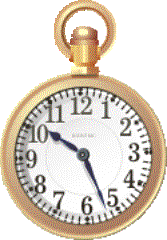
Teach your child to draw a circle for use in many alphabet letters by using a
clock face. Most of the round shapes in alphabet letters are formed by drawing
from 2 o'clock in a counterclockwise direction. Here's how to write an "a," a "c" or an "o," for example:
position the pencil at the point that would be 2 o'clock on the clockface. Form
the circular shape, working counterclockwise, and stop at the 4 o'clock
position if it's a "c," or continue to the starting point if it's an "o," or
continue upwards to the midline, then down to the baseline, for an "a." Print out this clockface or use a
real one to help your child practice that shape. To practice writing an "o,"
have your child place the pencil point on the "2" and draw the circle,
counter-clockwise, coming back to a stop on the "2" again. For an "e," the
child should start at the "3," draw counterclockwise and stop at the "4," then
draw a short line from left to right from the "9" to the "3." Practice:
●
Always teach a child to start at the top and stroke down on letters such as "b"
and "d," then add the round part. Round shapes are to be drawn in a clockwise
form if there's an "ascender" (the line that goes up in a "b" or "d") or a
"descender" (the line that goes down in a "p," for example). It's the same
thing with numerals: form them from the top, moving down, and never from the
bottom, moving up. If the child "freestyles," and draws lines from bottom to
top, draws circular shapes counter-clockwise when they should be clockwise, or
double-strokes on certain lines, you're setting the stage for dyslexia or
reading disability.
●
Almost all the letters should be formed in one stroke, without lifting the
pencil from the paper. That prepares a young child for the more flowing cursive
handwriting skills. Exceptions: lift the pencil to cross the "f" and "t," dot
the "i" and the "j," and form the two strokes of the "k," "x" and "y."
● Be
sure to remind your child that with writing, as with reading, we work from top
to bottom and from left to right. Tell them that words have a certain sequence
of letters to them, and that sentences have a certain sequence of words. The
simple, reliable order of handwriting is a good introduction to the simple,
reliable organization of word on a text. Approaching all handwriting tasks from
top to bottom and left to right establishes a good habit for your child to
adopt so that approaching a page of, say, math equations, isn't as
intimidating.
FOR MORE
HANDWRITING HELP:
The
Writing Road to Reading, a workbook on phonics and handwriting techniques
from www.spalding.org
Handwriting
Without Tears, a great workbook with exercises for young children as well
as older ones who need remedial help, www.handwritingwithouttears.org
 Creative Enrichment and Snack Ideas