
Science: Experiments
Little Drips -- A Sip
of Science
Today's Snack: We're going to be talking about drips, so let's make
a dip! Mix one cup of peanut butter with one cup of plain vanilla yogurt. Add ¼
cup of unsweetened coconut. Serve with fresh carrots, celery, cucumber slices,
or cauliflower tips. This is enough for 12 people. So cut the recipe down (make
a smaller quantity of dip by mixing ¼ cup peanut butter with ¼ C. plain vanilla
yogurt and just a tablespoon or two of coconut. Or make the 12-serving dip, and
call every dip you know to share it!
--------------------
Supplies:
Scratch paper and
pencil
Eyedropper
Plastic straw
Dime, nickel and
quarter
Plastic checker or
other small disk
Other items that are
small, flat and water-resistant
Small see-through
glass or cup
Straight pins
Water
Did you know there is an invisible "girdle" of
air that keeps water together?
Does it make you "tense" to find out
that there is surface tension in water? "Tension" does really have to do with
headaches, although often, where there is emotional tension, there will be a
headache.
No, "tension" means "stretching" or "straining." And
that's what's happening on the surface of water - to literally hold it
together. You can't see the tension, but you can see what it does to water
drops:
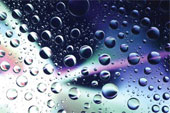
You've seen how drops of water will stick together
on a car windshield after a rain, for example. That's because there are many, many
molecules in a tiny drop of water. And they stick together. Surface tension is
a strong force that keeps water from spilling over.
Let's test it:
How many drops of water do you think
you can place on top of a dime with an eyedropper before the water spills over?
Write down your guess on a piece of scratch paper.
Now, carefully drop some drops. Count them as you
go. (If you don't have an eyedropper but are using a straw, dip the straw into
the water and close off the top end of the straw with your finger to "suck" the
water up into the straw, then release the finger briefly to let individual
drops fall, one by one.)
Keep counting. When the water finally spills over,
compare your guess with how many drops it actually took. Are you surprised?
That's surface tension at work.
Now try the drip test with the
larger coins - penny, nickel and quarter. Be sure to write down your guesses of
how many drops each coin will hold BEFORE you try it. Afterwards, review: were
your guesses a lot closer this time?
Now try the drip test on other
round, flat objects that you found, including a checker. How is your guessing
going now that you're getting some experience?
Last activity: fill a small glass or
cup to the brim, JUST before you think it will spill over. You might want to
use the eyedropper to fill it to the very, very fullest.
Now guess how many straight pins you can drop into
the cup before it spills over. Write down your guess.
Now, gently drop pins in, one at a time. As you go,
look at the cup from the side. What do you see?
Why doesn't it overflow?
How did your estimate compare to the result?
That's the principle of surface tension at work -
just one more little "drip" of science knowledge filling your cup of academic
excellence!
 Creative Enrichment and Snack Ideas